Indie Interviews


Can you tell us more about yourself and what led you to become an indie maker
It's a very long story because it all started 6 years ago, but I'll try to keep it short! 😅
I'm a software engineer from Brazil 🇧🇷, but I currently live in Ireland 🇮🇪. I've always liked to build side projects on my spare time to learn new things. My first serious side one was an open source feedback collection platform called Fider. I built it because I wanted to learn Go and React, which were trending at that time.
During the early days no one was actually using it because it had to be self-hosted. I decided to offer free hosting because at that time I would only cost me $5/mo, regardless of how many users I had on it. I didn't expect people to sign up, but they did. I started getting a few users every day and it kept growing. I was very happy with it, but I never thought about monetizing it.
In 2021, 5 years later, I learned about the indie hacking movement and how people were making money online competing with the giants. I had this site with a few thousands users and growing monthly, so I decided to give indie hacking a try to see if anyone was willing to pay for it. I started by adding a paid plan to Fider. I was blown away by the response. It was the first time I made money online and it felt amazing. I was hooked!
Fider was the spark that ignited the indie hacking fire in me. In 2022, I launched Aptakube, a Desktop Client for Kubernetes. The launch was a success and the community reception was amazing. After only 6 months working on it, I decided to quit my job and work on it full time 🚀
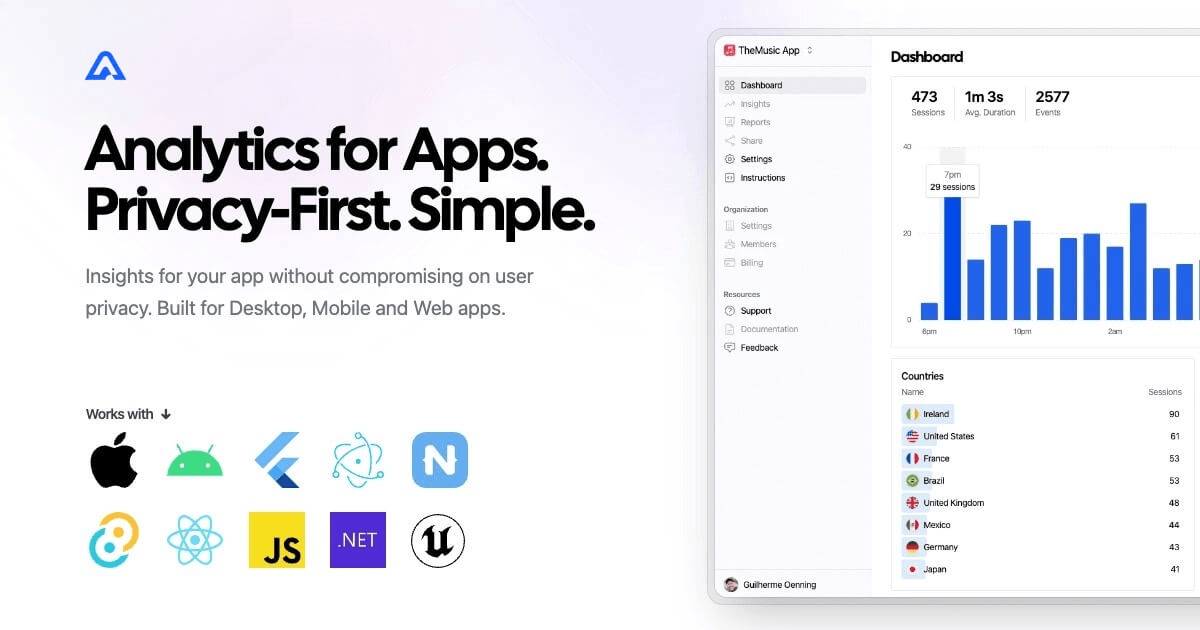
I recently found a gap on the market and decided to build my third product. Aptabase is an analytics platform for mobile and desktop apps, with a big focus on privacy. I'm still very early days, but it's already generating revenue and growing nicely.
As I currently spend most of my time on Aptakube and Aptabase, I'll focus on them for the rest of the interview 😊

How did you come up with the idea? How do you generate ideas for your apps or projects, and how do you identify the problems or needs your app can address?
I was working with Kubernetes on my day job and I wasn't happy with the alternatives. They didn't have some features I wish they had, so I decided to build my own app. I started by building a prototype and sharing it with the community. The feedback was amazing and when I put a price on it, people were happy to pay for it.
While working on Aptakube I realised I didn't have any insights on how people were using it, what features they were using the most, the operating system, etc. I'm a big fan of Plausible for website analytics, but I couldn't find anything similar for desktop apps, which led me to build Aptabase.
One of the best lessons I learned from this experience is that an idea doesn't have to be original. You can build something that already exists, but just take one feature of it and make it better. The more I work on these two products, the more ideas I have for new products, it's a never ending cycle 😅
How does your day-to-day app development workflow look like?
Because I work full time on these products, I have the luxury of working on them during the day, instead of side hustling as I was doing before. It took me some time to find a routine that works for me, but I think I finally found it.
I alternate between the two products quite frequently. I spend 2 weeks working on Aptakube and the other 2 on Aptabase. I try to keep a balance between new features, bug fixes, customer support and marketing. I still suck at marketing, but I'm working on it!
How do you launch and market your app?
I launched Aptakube on Reddit and the reception was fantastic. There were loads of negative comments, but haters gonna hate, right? 😅 On the other hand a lot of people were interested in the product and I got a lot of constructive feedback. However you have to be careful with Reddit or else you get banned, being part of the community is important, so don't just go there to promote your product.
I also tried Product Hunt, but it didn't work for me. I think it's because Aptakube is a very niche product and it's hard to get traction on PH for certain niches. My marketing strategy is mostly SEO, content marketing and word of mouth. I get a support requests from potential users and I try to convert them into paying customers by going the extra mile during the trial period. It has worked quite well so far.
As for Aptabase, I haven't marketed it that much yet. I haven't even officially launched it 🤣 I still have a few things I want to do before launching it on Hacker News and Product Hunt. However I tweet quite a bit about it, so most of my users come from Twitter and organic search. I'm happy with the growth so far, but I'm still trying to figure out the best marketing strategy for it.
What are the future plans for your app?
I have a lot of plans for both products. Aptakube's roadmap is driven by user requests. I have a public roadmap where users can vote on features they want to see implemented. I also have a few ideas of my own, but I try to prioritise user requests first to make them happy. Saying "No" to users is hard, but it's something I had to learn to do. I don't implement every feature request, but I try to implement the ones that I feel like will benefit a large number of users.
Aptabase is a bit different. Most analytics products start simple and grow into a complex and feature bloated product. I want to avoid that. It's one of the reasons "Simple" is part of the tagline. Aptabase is and will remain simple. There's still a few key features I want to implement, but I'm taking it slowly to make sure I don't over complicate it.
I also have plans for a new product later this year 😊 I can't say much about it yet, but it'll be small and hyper focused on doing a single thing really well.
Do you have any interesting lessons learned or tips for other indie makers?
-
✨ The more products you build, the more you learn. Don't be afraid to fail, it's part of the process. You also get to find quite a few challenges along the way which leads to new ideas.
-
✨ Be consistent and keep shipping, always. Building a product is like long-term investment. If you put $100 dollars and walk away, it'll never grow. If you build a product and expect users to find it and pay you, I'm sorry, it doesn't work that way. You have to keep investing on it constantly to make it grow.
-
✨ Don't be afraid to charge a premium for your product. I've lost count how many times I've heard that $99 is to expensive for my product, but there are people still buying it every day. If you've got a good product that solves a problem, people will pay for it. Don't be afraid to charge what you think it's worth. You can always tweak the price later.
Looking back, are there any decisions or actions you regret not taking before or during the development and launch of your apps? Is there anything you would have done differently?
I should have started monetising earlier, much earlier. That was a big mistake I made with Fider, which I fixed on all the subsquent products I built. I wish I could go back 6 years and had subscriptions ready to go from day 1, but it is what it is. We learn from our mistakes and move on.
The other mistake was leaving my 9-5 job too early. At that time, sales were trending up and I thought that spending more time on it would make sales go up faster, but it didn't. While employed my products were a side-project that made some decent money. But as soon as I quit my job, they became my main source of income and I had to worked longer hours and still earn significantly less. It was a very stressful time, especially at the beginning. I'm glad I have a supportive wife who helped me through it.
Are there any other products that you are particularly proud of? Could you share some details about them
Too many to mention them all, but to highlight a few:
- I'm a big fan of Proxyman and love reading Noah's stories on Twitter
- I use Plausible on all my websites and was the inspiration for Aptabase
- LogSnag is really well thought out and I love the minimalist design
- The design of Screen Studio and the story behind it is also very inspiring
Are there any indie makers or creators whose work you admire and follow closely?
There's so many, but here's a few:
- SebastianRoehl from HabitKit
- Adam from Screen Studio
- Noah from Proxyman
- Andras from Coolify
- Tony from Xnapper
- Peter Levels, the OG indie?
Could you recommend any specific tools or resources that you believe are helpful for other indie makers, especially those just starting out?
Because my products are not on a marketplace like App Store or Google Play, I had to find a different way to get them in front of potential users.
I'm heavily invested in SEO and content marketing, but I travel light when it comes to tools. I use Reddit for content ideas and Google Search Console to track performance and some keyword research. I've read a lot about SEO over the years and I would recommend other indies to learn the basics of it. It's a long term investment, don't expect immediate results, but it pays off in the long run. After 1 year of working constantly on Aptakube, I usually get 500 daily visits from Google searches alone.
Thanks for reading til the end. Hope you enjoy the interview as much as we did. Below are some useful links mentioned throughout the interview
Indie Interviews by Indie Goodies is all about discovering and showcasing indie makers. We firmly believe that behind every app, there's an inspiring tale of passion, creativity, and perseverance. We're always on the lookout for aspiring indie makers to feature in our series, and if you have any suggestions or recommendations, we'd love to hear from you.
Once again, thank you for joining us on this journey. Your support means the world to us. Until next time, keep supporting indie makers, keep exploring innovative apps, and subscribe to Indie Goodies interviews for more.