Indie Interviews


Can you tell us more about yourself and what led you to become an indie maker?
Hi, I'm Cihat – say like "Jeehut" (my handle on socials), I'm 32 and I do iOS development for 12 years now. Besides my Indie apps, I'm also the author of the Swift Evolution Monthly newsletter, I post dev articles on my blog, and recently I became the maintainer of the WWDC Notes project.
To explain my motivation to become a full-time Indie, I have to jump back to my 16-year-old self: That's when I started understanding how the world works and where the global problems are. I dreamed of helping fix some of the systemic problems in the world causing a lot of pain to millions of people. Big topics like that money doesn't have a meaning and therefore creates a big gap between the poor and the rich. Or that the way we discuss and make decisions as organizations or as a society does not cover the real needs of the people who are affected by these decisions. Or that we all live in an achievement-oriented society which would be great if everybody had the same starting chances, which is by far not the case though and we're not really getting closer there.
Initially, I considered going into politics, becoming a journalist, or making movies. I thought that this way I could show others the core problems I saw and offer some ideas for solutions. However, over time, I learned that the real missing part was solutions that were obvious or easy enough to convince the general public. But then, social media sites like Facebook revolutionized the way we communicate and the iPhone brought the internet to all the places humans can go. This taught me that only through technology and software, it is possible to win millions of people over for a new idea and that this was the fastest, easiest, and most peaceful way to have a positive impact on a large established system.
So, I decided to become a software developer, and only because of this, I studied Computer Science. Naturally, I wanted to do iOS development as the "it's with you everywhere" aspect was crucial for any more interesting ideas I had. To learn as much as possible, I went to an App Agency, where I quickly became the iOS department lead and worked on many different apps using different technologies. Once I felt experienced enough, including in topics like Design and Backend development, I wanted to start working on some of my simpler ideas to enter the next phase of my journey.
In order to really serve the real purposes of the apps I'm planning and not risk them becoming money-driven ideas that lost track of their mission, I decided that I had to become financially independent. So I took on a manager role in a different company where I led a Mobile team until I had saved enough money to go full-time as an Indie developer for 2 years. That's the time I've set for myself to become financially independent. If I can't do it, I'll reconsider, but if it goes well, I can start working on the stuff I really care about. But first, I need to cover the financial part. I have until May 2024 which is less than a year, so I need to keep up the pace!
How did you come up with the idea? How do you generate ideas for your apps or projects, and how do you identify the problems or needs your app can address?
In general, all my app ideas are driven by bad experiences or problems I've had, or I've heard someone have. My brain is programmed to help people and to provide the smoothest possible experience to anybody at any time. That's simply who I am. So when there's a sub-par experience, like when I'm coding in Xcode and I want to translate the app to many languages and I know there are machine-translation services, I wonder why they are not integrated into Xcode. That's a problem with an obvious solution, which later became my open-source tool BartyCrouch and its successor and my first Indie app RemafoX.
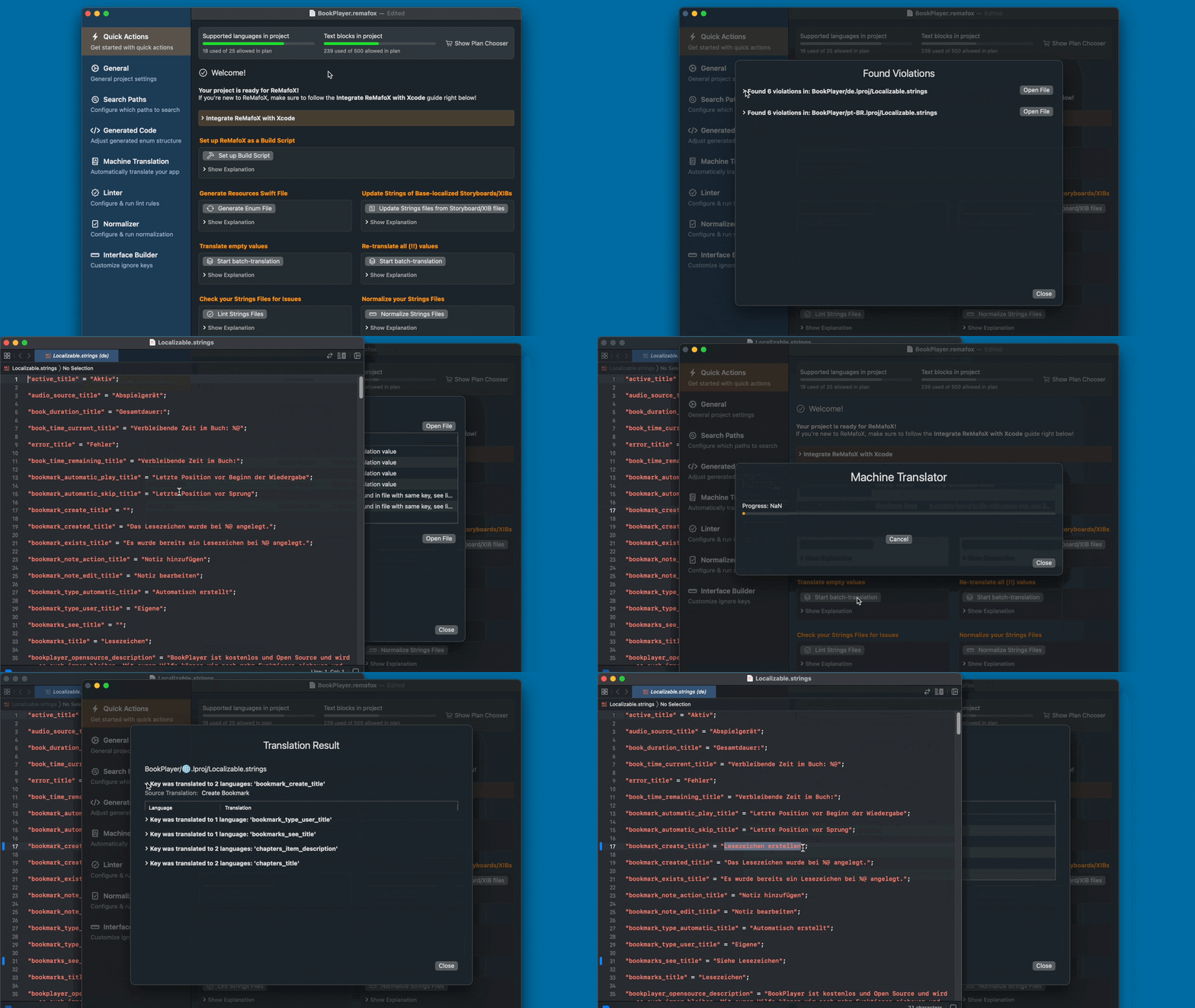
I use the same approach for feature ideas, too. Like that one time when we shipped a new feature with new localized texts and users reported that they saw English text in an otherwise German app and we fixed it manually, I immediately thought: Shouldn't Xcode check that all languages are fully translated? So I've built a feature to show a warning in those cases into BartyCrouch and later RemafoX. Apple has followed the same path now by providing a warning as well, which you will benefit from if you migrate to String Catalogs (in Xcode 15 and later).
The big problem with these kinds of ideas is, that they come at very random times. Especially at times when I might not be able to write them down immediately, like when I'm in the shower or lying in bed. Learning from Getting Things Done by David Allen, I built a habit of always writing my thoughts down, which I can only recommend to everyone. Over the years, I collected hundreds of app ideas, and I also evolved my solutions for the systemic problems I mentioned above.
Recognizing a problem alone does not make a good app idea, though. You also have to think about it and you need to know the possibilities and limitations of Apple's system frameworks and other open-source tooling or 3rd-party services. That's why each year during WWDC, I take the full week off and watch all the "What's new in
This and the fact that I've already used many different frameworks and like to explore things in code from time to time really helps in coming up with solutions for problems, which in return helps a lot to come up with actual app ideas.
How does your day-to-day app development workflow look like?
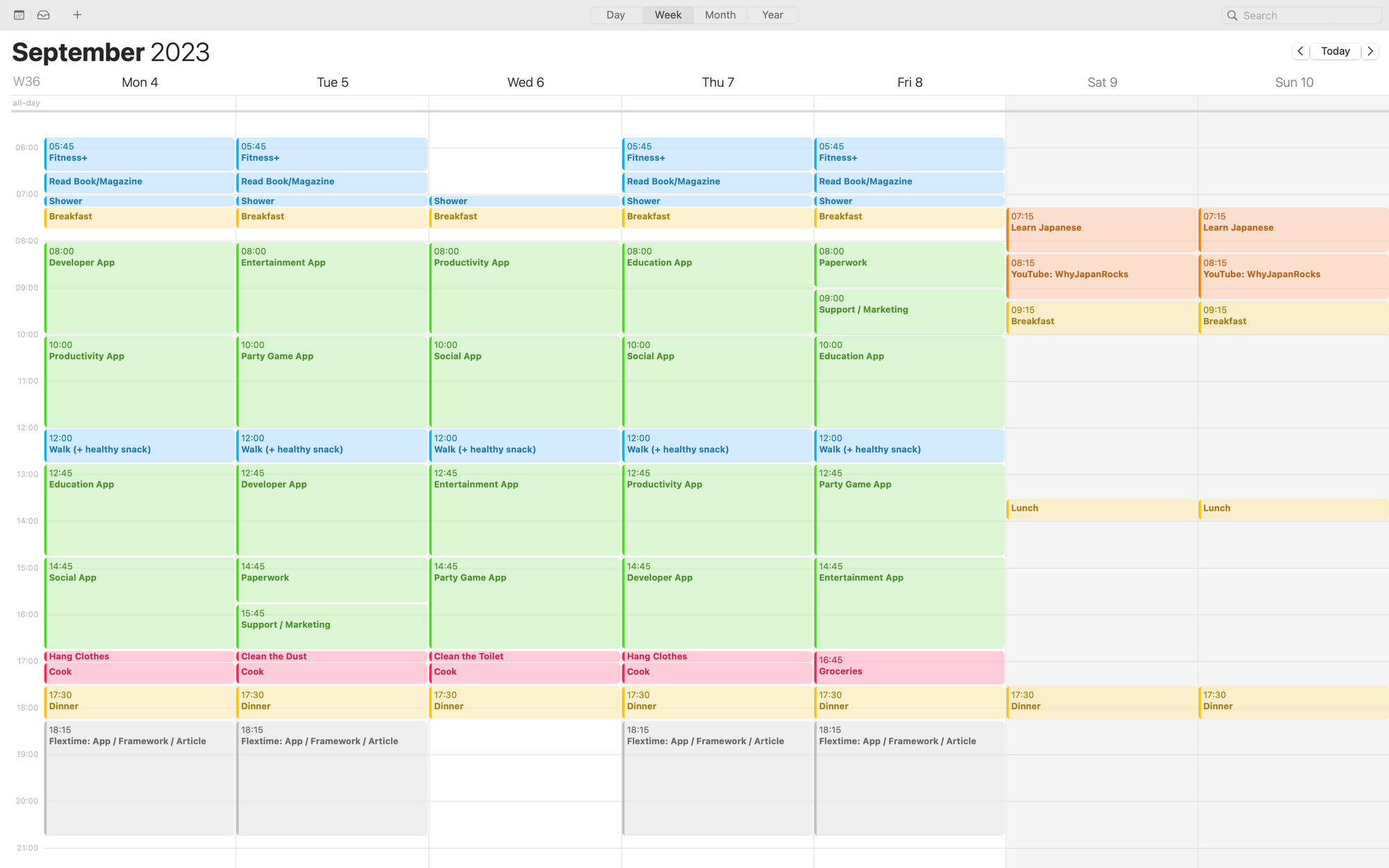
I wake up at 5:30 in the morning and do 30 minutes of training in Fitness+. Then I read a non-fictional book or IT magazine to educate myself for 30 minutes. At exactly 07:00 AM, I shower and have breakfast, all before even looking into any of my inboxes or notifications on my phone. I use a focus mode which hides all app screens & notifications to make it work. This morning routine is really important for me to have a productive start to the day. I only skip the exercise on Wednesdays (and Weekends) where I wake up at 06:30 instead to give my muscles some rest and get some extra sleep. And I totally notice how I have less energy and get distracted more on Wednesdays, so the positive effect of the morning workouts is very noticeable.
On top of my morning routine, I also do a 45-minute walk every day during my lunch breaks. I use this time to listen to podcasts and do grocery shopping. During my actual work time, I use the Pomodoro technique with 25 minutes of work and 5 minutes of breaks in between. This helps me stay focused without distractions and the the breaks are perfect for doing chores, which also make me move a bit – the perfect complement to reduce back pain and eye strain.
The work starts at 08:00 AM. 3 times a week, I have a co-working call for 4 hours in the morning with a fellow Indie Flutter developer. The purpose of this is to motivate each other to show up and to stay focused, which works well because there's someone watching you. We also discuss our goals and what we've achieved at the start, the middle, and at the end for a couple of minutes. This helps me also with the problem that working at home alone all the time can feel a bit lonely long term. For this purpose, I also do a bi-weekly exchange call with another fellow iOS Indie developer where each of us gets 30 minutes to talk & get feedback.
Coming back to my daily routine, I currently work on 7 new apps at the same time. To make progress on all apps every day, I first tried splitting my day into 8 one-hour long slots with 7 of them for my 7 apps each and 1 hour for other topics like paperwork, support, or marketing. But the context switch overhead was real, and some more complex functions I wanted to write didn't fit into an hour. So I changed to 2-hour slots instead and I've stuck to that since!
A 40-hour week has 20 two-hour long slots. 7 doesn't fit into 20, so I made one app category "optional" and moved it to my evenings where I do any additional work like writing articles & newsletters or doing open-source stuff (which I used to do as livestreams on Twitch, but few people watched and it slowed me down).
Another thing I've learned from the seven 1-hour slots per day experiment was that if I overslept or came back late from my walk, it was always the same apps that suffered since I had to skip their slots to stay on time for dinner. As a consequence, I distributed the 6 apps with 3 slots each (18 slots in total) at different times throughout the week. The 2 slots left are for paperwork, support, or marketing.
As a result, this is what my week and daily routine currently looks like:
How do you launch and market your app?
This is the part I'm still learning. I'm currently reading a book about Marketing, but I wouldn't say I'm in a position to give advice. All I can say is that my initial approach was to provide a high-quality product with a clear benefit for the users, create a landing page for it with a PressKit (see remafox.app & twoot-it.app), post about it on Twitter & Mastodon using their own accounts (see @RemafoX_App & @Twoot_it), and let word of mouth help me reach more people. Additionally, I planned to reach out to some related blogs or news sites, which didn't make a lot of sense for RemafoX because it is so developer-specific, but I did that for my cross-posting app Twoot it! and it was featured on a German blog.
But with my first app released in October 2022 right before I left for a 3-months travel throughout Japan, that was not enough. Maybe it was that I couldn't add more features in the months right after because I was traveling. I can't say for sure. I tried showing off the advantages my app had by creating GIFs that clearly showed its advantages. Even the completely free features that I added to celebrate WWDC didn't convince developers to download it. Maybe the developer community is more reluctant to try new workflows than I thought.
But my takeaway is that quality alone does not make an app successful. Adam Stinson, a marketing expert who contacted me on Twitter, gave me the advice that Indies should focus on building relationships with specific potential customers and build their apps for them and grow this way. He said, that a common mistake is to follow the example of venture-backed companies which grow through social media, but that this is not a good way for Indies. His argument was: If you can build enough relationships to have 1,000 "fans" of people who are willing to pay you $100 per year, that's already a $100k business which is a totally achievable goal with low risk. I plan to follow his advice in the near future.
What are the future plans for your app?
Twoot it! will not see much love unless people start actually using it. Currently, I don't have any paying customers and only 50 downloads per month. It may be too niche of an app and I had to ditch some Free features due to the new Twitter API pricing. I view it as an app I wrote mostly for myself.
RemafoX is different, I've put a lot of work into it and it works pretty well and has lots of localization-related features. While it has even fewer downloads per month with just 30 in August, it does generate more than $100 per month on average. That's not much, but it shows that there's potential for more. Until now, I focused on low-level features like parsing/linting/normalizing Strings files. In the future. I will focus on higher-level features that are meant to help improve the quality of translations.
As one of my 7 app projects, I'm working on a framework that developers can integrate into their apps which automatically detects users who speak a language the app doesn't (fully) support yet. Then the framework asks the user at an appropriate time with a dialog if they want to help translate the app. For the user, it's just a minute with only ~5 pre-translated text snippets. All they need to do is say "This is correct" or "Let me fix this". By using the power of the crowd, Indie developers will be able to easily support more languages with confidence!
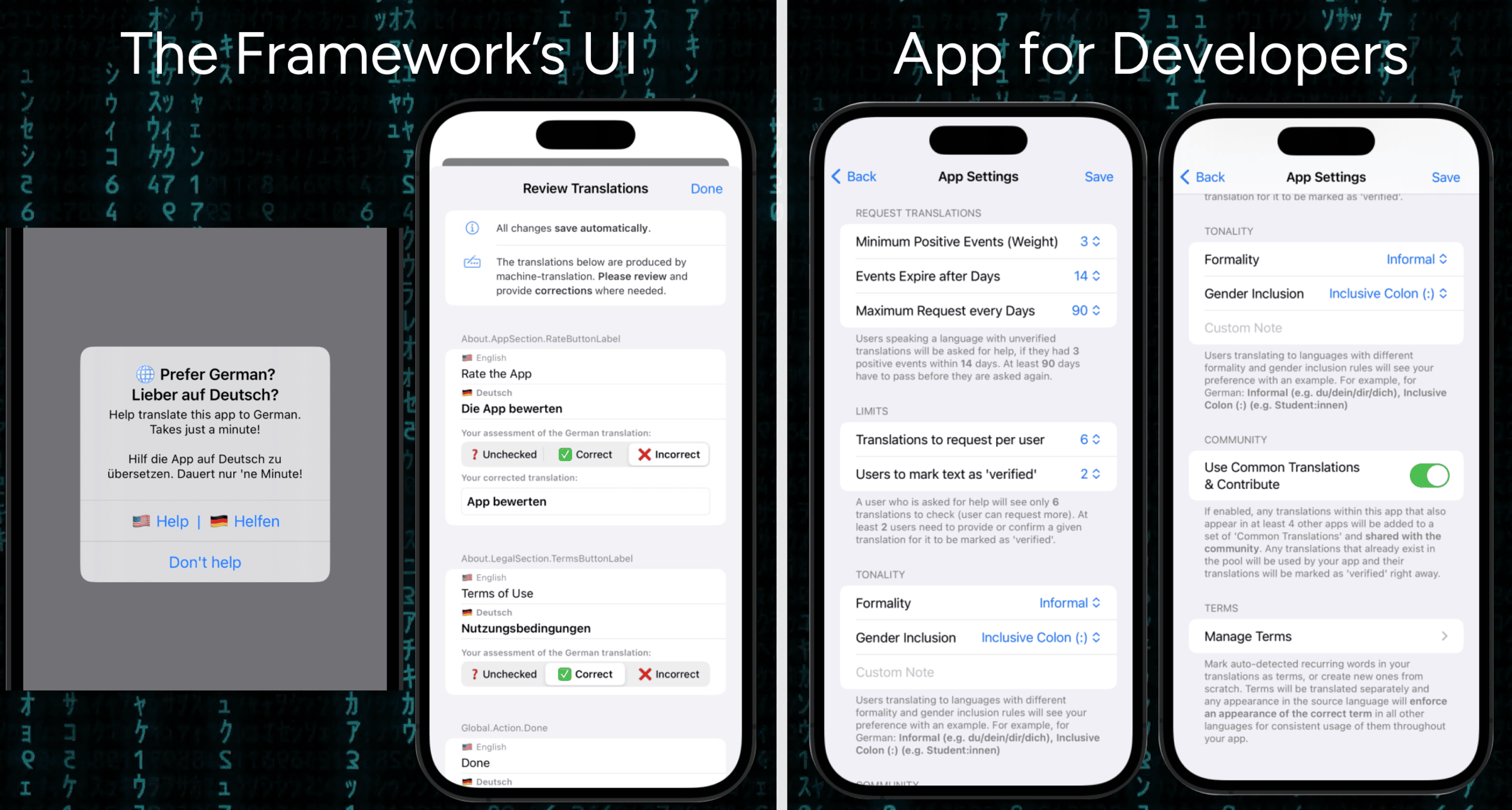
The framework will provide a lot of flexibility to developers to cover various use cases. There will even be an optional "Community Translations" feature to provide something like what "SF Symbols" provides for icons: A collection of common text snippets with translations to a whole bunch of languages. I will contribute some initial data there, but over time, when developers widely use it, it could grow into a really useful set of texts that help alleviate the need to validate common texts like "Save", "Done", or things like "Privacy Policy".
Do you have any interesting lessons learned or tips for other indie makers?
Don't do open betas with a TestFlight Beta link. While you will get more beta testers, you won't get more (detailed) feedback. Do an invite-only closed beta instead, where you need to invite people via email and people need to message you. I received useful feedback from half the people I invited this way.
Limiting the time you have to work on an app clears your mind for what's really important. I tend to refactor too much, write reusable code too much, and extract code to publicly shareable frameworks too much. I have time for none of these traps when I only have 2 hours for each app in a day because I want to make progress. For extracting code or refactoring, you can plan an extra time slot.
Don't provide public time estimates. It will only make you rush or stress you out. At least learn from Apple and say things like "planned for early next year" and be flexible about what that means for you (at least in your mind).
Focus on your strengths. I have lots of ideas. I know lots of technologies. I worked in an agency on many projects, switching regularly. So I decided to do multiple apps all at once because that uses my strengths. I'm used to that, it makes me happy. Your strengths may differ. Maybe you know a topic extremely well. Or you have high motivation for a specific game or franchise and even have connections there. Use these things to your advantage! Don't try to copy others without reflecting on yourself. Learn from them, and take advice. But don't copy. Do your own thing. Be different. And learn from user feedback. It's the #1 resource.
To keep a clear focus and remind me of the next milestone when switching between apps, I came up with my own version of TDD: "Twoot Driven Development". Before starting to work on any of my apps, I write a post that I deem worth sending out on Twitter & Mastodon to my followers. Sometimes it's as obvious as a new screen, or an animation. Sometimes it's something like that my server or API is done, or that I integrated my app with Game Center. In these cases, I try to share a learning or how hard it was, or how long it took. Then, each time I start working on an app, I read the next post of the app and remind myself that whatever I will work on in the next 2 hours needs to bring me closer to it.

Looking back, are there any decisions or actions you regret not taking before or during the development and launch of your apps? Is there anything you would have done differently?
I think I wouldn't have gone for a low-level topic like Strings file handling. It takes time to get right and it's way harder to market. And Apple could sherlock the feature anytime. It's good for a side project. But not for your first app.
I probably shouldn't have chosen a Mac app in the first place as my first app. Having near to no experience on the platform, I thought SwiftUI had me covered. And it did for the most part, even though SwiftUI on the Mac isn't as mature as on iOS. AppKit is not my strength. Should have focused on my strengths more.
Are there any other products that you are particularly proud of? Could you share some details about them?
I am proud of the movie discovery app I wrote in 2014, which also helped me get an Apple WWDC Student Scholarship that same year, and let me experience the awe of the crowd when Craig Federighi announced Swift with his famous words: "What would it be like if we had Objective-C without the baggage of C?"
The app died unfortunately because I didn't know how to write a scalable movie prediction algorithm back then, and I couldn't pay the server bills as a student. But I am now working on its successor, which is going to be a mix between a media player and a discovery app. So fun working on!
The other apps I'm building are a flexible day planner, an app to play the famous Categories game in a group, a long-term contact-sharing app with full privacy controls, and an app for generating custom crosswords, which I used to generate a decently challenging crossword for the iOSDev community.
Are there any indie makers or creators whose work you admire and follow closely?
I love the work done by Brandon Williams and Stephen Celis. They provide so many tools for writing more correct code and they improve testing our apps.
I'm also impressed by people like Naftali Antebi for developing & shipping apps entirely on the iPad using Swift Playgrounds.
And of course: My friend, bi-weekly exchange, and podcasting partner Nico, who runs the coolest NFC app out there and very successfully so. As well as my latest friend, fellow streamer, and coworking partner Verry, who's a Flutter developer and currently works on improving her already-great app for 🥁 drummers.
Could you recommend any specific tools or resources that you believe are helpful for other indie makers, especially those just starting out?
I already mentioned Brandon & Stephen above. Besides their infamous and advanced project TCA, they also have smaller packages I use all the time: CustomDump has an XCTAssertNoDifference method providing better diffs for testing. IdentifiedCollections allows to access elements in arrays of Identifiable instances fast with a subscript. And Tagged allows creating different flavors of a UUID for each of your models for safer id parameters.
For translating apps, I can of course recommend my app RemafoX. It's totally free to use for Indie-sized projects. And I plan to open it up even more in the future.
I like to extract any code that I can reuse in multiple apps into the libraries HandySwift (for Swift code) and HandySwiftUI (for UI code). To determine when to ask users for an app review, I wrote ReviewKit. More frameworks are in the works about other useful topics both for beginners and experienced devs.
From time to time, I like to see how much code I've written – either to share publicly or to compare the general size of different projects. I use tokei for that.
Sometimes, when I want to open a very large file Xcode struggles with, or when I want to edit files Xcode doesn't show like the .gitignore file, I use Sublime Text. An open-source project with a similar goal for the future I follow is CodeEdit.
I used Git-Fork as my go-to GUI for version control. But with Xcode 15, I mostly switched to using Xcode, which doesn't have the best UI yet, but it's improving year over year and finally, it supports enough features that I can use it.
Lastly, with so many projects I need to switch between, I appreciate the app XCOrganizer by Sergii Kryvoblotskyi, which was definitely worth its $2 price tag.
Thanks for reading til the end. Hope you enjoy the interview as much as we did. Below are some useful links mentioned throughout the interview
Indie Interviews by Indie Goodies is all about discovering and showcasing indie makers. We firmly believe that behind every app, there's an inspiring tale of passion, creativity, and perseverance. We're always on the lookout for aspiring indie makers to feature in our series, and if you have any suggestions or recommendations, we'd love to hear from you.
Once again, thank you for joining us on this journey. Your support means the world to us. Until next time, keep supporting indie makers, keep exploring innovative apps, and subscribe to Indie Goodies interviews for mo